Free US shipping on every order
Ninja Costume vs. Real Ninja Uniform: What $25 Buys vs. What $70 Buys
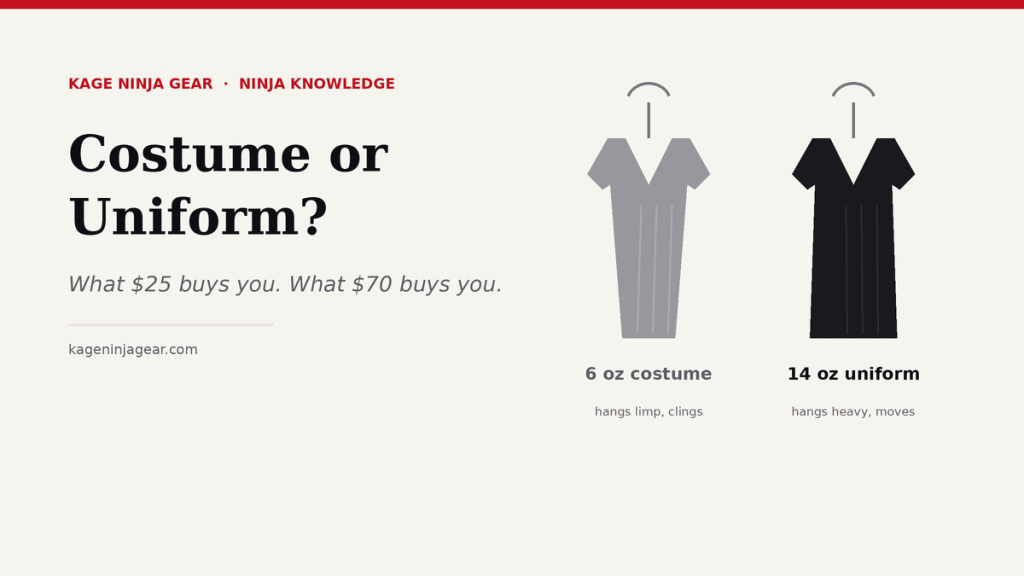
Every September I get some version of the same email. Someone has found a ninja costume for twenty-five dollars and a ninja uniform for seventy, and the photos look close enough that they want to know what they’d actually be paying for.
It’s a fair question, and the honest answer isn’t “ours is better.” It’s that they’re two different products that happen to share a silhouette. One is designed to look right in photographs for one evening. The other is designed to be worn. Which one you want depends entirely on what you’re doing with it — so here’s what actually differs, and where each one makes sense.
The whole difference starts with fabric weight
Fabric is sold by weight per square yard, and that single number drives almost everything else.
A party-store ninja costume is typically around 6oz polyester. That’s light, cheap to ship, quick to cut and sew, and it photographs fine. It’s also thin enough to see the outline of your clothes through, it clings when you sweat, and it makes a papery rustle when you move — which is a particular kind of irony in a ninja costume.
Our uniform is 14oz cotton. More than twice the weight. Heavy fabric hangs away from the body instead of clinging to it, which is why it reads as clothing rather than as a costume in person. It moves quietly. It takes a wash without pilling or going shiny. And it’s opaque, which sounds like a low bar until you’ve seen a thin costume under a porch light.
Where costumes actually fail
Weight isn’t the only difference, but it explains most of the others.
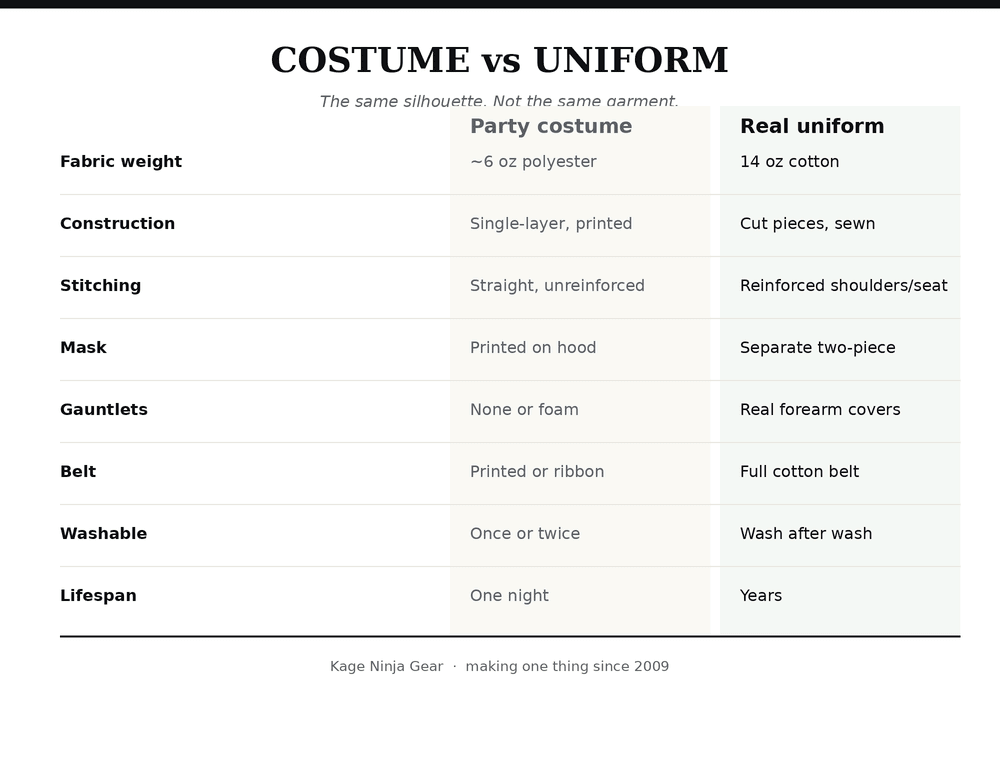
The mask is usually printed, not made. On most costumes, the “mask” is a hood with a face shape printed or stitched flat onto it. A real setup is a separate hood and face wrap you tie yourself — which is why it stays put when you turn your head. It’s also why our uniform includes an actual two-piece ninja mask rather than a printed panel.
Stitching goes where it’s cheap, not where it’s needed. Costume seams are a single straight pass, the same at the hem as at the shoulder. A uniform gets reinforcement at the shoulders and the seat — the two places anything you actually move in tears first. Ask anyone who’s crouched down in a costume and heard the sound.
Accessories are suggested rather than supplied. Costumes tend to print a belt onto the fabric or include a ribbon. Ours comes with a real black belt, plus gauntlets — proper forearm covers, the modern version of the tekko that shinobi actually wore. If you want the full traditional kit, leg wraps and the utility belt complete it, and the Professional package bundles all of it together.
Sizing is guessed. A lot of costumes come in “one size fits most” or a three-size range. We size XXS through XXL against a real chart with heights and weights, because a uniform that doesn’t fit doesn’t move right, and because guessing is how people end up returning things.
When a $25 costume is the right call
I’d rather tell you this than have you buy the wrong thing from me.
If you need a ninja outfit for one party, you’re not planning to wear it again, and you want to spend as little as possible — buy the costume. That’s what it’s built for, and it will do that job. Nothing about paying more makes a single Halloween night better.
Buy the real uniform if any of these are true: you train in martial arts, you’re going to wear it more than once, you cosplay and people will see it up close, you’re a teacher or performer who needs it to survive repeated use, or you simply want the thing itself rather than a picture of it.
The math nobody does
A costume at $25 that survives one Halloween costs $25 a wear.
Our 14oz uniform is $69.95. Wear it three Halloweens and it’s $23 a wear. Wear it to class every week and the number stops being worth calculating. I’ve had customers write in with uniforms from our first years still in rotation — that’s the part I’m proudest of, and it’s the entire reason we build them at 14oz instead of chasing a lower price.
That’s also why we don’t run coupons. The price is the price, we make about five hundred a year, and the fabric is where the money goes.
The short version
- Costume fabric runs about 6oz; our uniform is 14oz cotton — more than twice the weight
- Heavy fabric hangs instead of clinging, moves quietly, and survives washing
- Costumes print the mask and belt; a real uniform supplies them as separate pieces
- Reinforcement goes at the shoulders and seat, the two places that fail first
- For one night, a costume is genuinely the right purchase
- For anything more than once, cost per wear favors the uniform quickly
If you want to know what the historical version looked like before Hollywood got to it, we wrote about what real ninjas actually wore — and about which ninja weapons were real while we were at it. Sizing questions are welcome anytime; the size chart is on every product page.
— Kevin Kage Ninja Gear · Making one thing well since 2009