Free US shipping on every order
What Did Real Ninjas Actually Wear? (Not What the Movies Show)
Seventeen years of making ninja uniforms means seventeen years of answering one question at conventions, in emails, and once, memorably, from a customs officer: “Did ninjas really wear that?”
Short answer: not exactly. Longer answer: the truth is more interesting than the movies, and it explains why a real ninja uniform is built the way it is.
The all-black ninja suit came from the theater
Here’s the part that surprises people. The head-to-toe black outfit we all picture didn’t come from feudal Japan’s battlefields. It came from the stage.
In traditional Japanese bunraku puppet theater and kabuki, stagehands called kuroko dressed entirely in black. The audience agreed to treat them as invisible. So when a playwright wanted to stage an assassination, there was a brilliant trick available: have the “invisible” stagehand suddenly draw a blade. The audience gasped — the killer had been standing in plain sight the whole time. Black clothing became the visual shorthand for “person you cannot see,” and by the time woodblock artists like Hokusai were drawing ninja in the early 1800s, the black suit was locked into the popular imagination. It’s been there ever since.
Real shinobi — the spies, scouts, and saboteurs of the Sengoku era — had a different priority. Their job was to not look like ninjas.
What the historical record actually says
The surviving ninja manuals, like the Bansenshukai (1676) and the Shoninki (1681), spend far more pages on disguise than on combat. The Shoninki famously describes seven disguises — wandering monk, traveling merchant, performer, priest, and so on. A shinobi crossing enemy territory dressed as a farmer, because a farmer draws no second glance.
For actual night work, the manuals recommend dark clothing — but not pure black. Pure black reads as a hard silhouette against the sky and stands out on a moonlit night. The practical colors were deep navy blue, dark brown, and persimmon-dyed shades. Navy had a bonus: indigo dye was cheap, everywhere in rural Japan, and folk wisdom held that the dye repelled insects and even vipers. When your commute is a hedgerow, that matters.
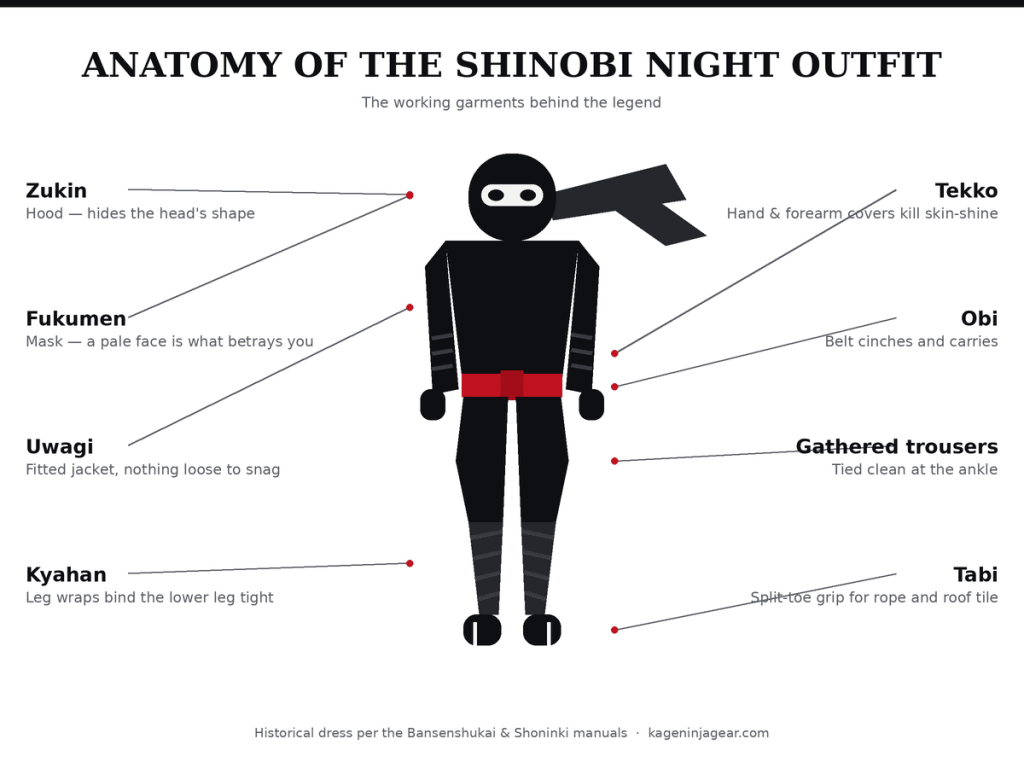
The working outfit itself was practical field dress, and if you lined it up next to a traditional uniform today, you’d recognize every piece:
- A jacket that closes tight to the body, so no loose fabric snags or flaps
- Trousers gathered at the ankle, keeping the leg clean for climbing and crouching
- Kyahan — leg wraps binding the lower leg, the same gaiters worn by travelers and soldiers all over old Japan
- Tekko — hand and forearm covers, protecting the hands and killing skin-shine
- A hood and face covering (zukin and mask) that hid identity and broke up the pale shape of a face in the dark — the single most visible part of a person at night
- Tabi — split-toe footwear, which is the piece people underestimate most. The separated big toe grips rope, roof tile, and rock in a way a solid shoe cannot. Japanese construction workers still wear tabi boots on high steel today, four hundred years later, because nothing grips better.
So the movie image isn’t wrong so much as compressed. Take a real shinobi’s night kit, dye it black for the stage, and you get the costume. The function underneath was always real.
Why this history is sewn into our uniform
When I started making uniforms in 2009, this was the question that drove the design: do you build the theater costume, or do you build the working garment?
We chose the working garment, in the iconic black everyone actually wants to wear. That’s why a Kage ninja uniform is cut from 14oz cotton — heavyweight fabric that moves quietly and survives training, not the 6oz tissue that party-store costumes use. It’s why the set includes the hood, mask, and gauntlets as separate functional pieces the way the originals were, instead of printing them onto a jumpsuit. It’s why the pants tie off clean at the ankle. And it’s why we make real split-toe tabi socks to go under it — because the grip is the point.
Four centuries of field use worked out the design. We just refuse to cheapen it.
The quick version
- The solid-black “ninja suit” is theater convention, born from kabuki stagehands the audience pretended not to see
- Real shinobi dressed mostly in disguise — the goal was invisibility by blending in, not by dressing dramatically
- For night operations they wore practical dark field dress: fitted jacket, gathered trousers, leg wraps, hand covers, hood and mask, split-toe tabi
- Deep navy and dark brown beat pure black in real darkness
- Every piece existed for a job, and that’s the standard a real uniform is still built to
If you want to go deeper on the tools they carried, we’ve written about the weapons real ninjas actually used. And if you’d rather just wear four hundred years of field-tested design, you know where the uniform is.
— Kevin Kage Ninja Gear · Making one thing well since 2009